
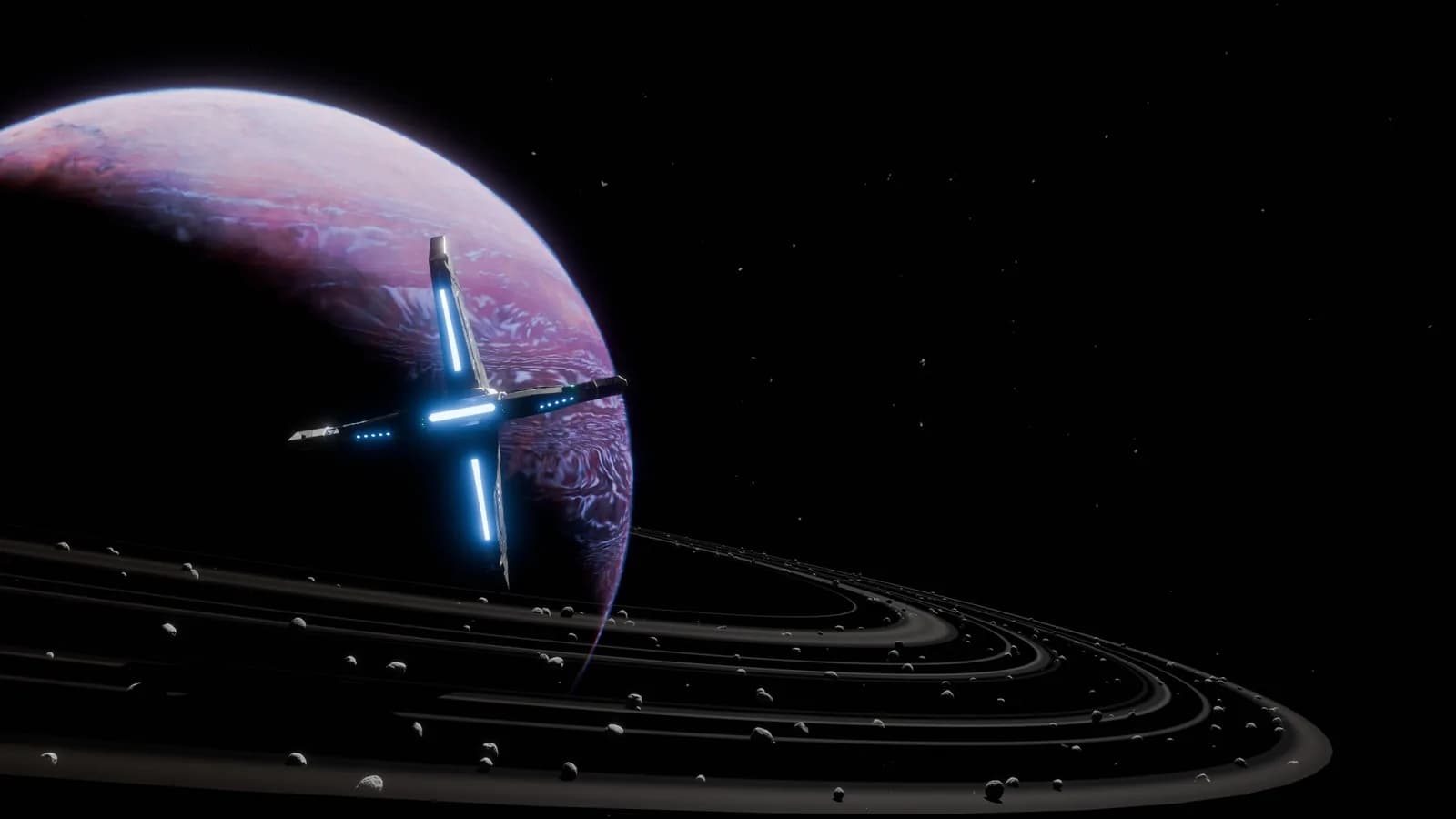
In the popular Science Fiction movie Star Trek: First Contact, the turning point for the human race is not when we unify as a single people, not when some multi national agreement is signed, it was when a inventor Zephram Cochrane, created a spaceship with an experimental Warp Engine.
That event transformed the human race. We went from a planet in chaos to the founders of “United Federation of Planets”, an utopia of not just the Human race, but more than a dozen alien races united in the best ideals Humanity came up with.
Star Trek makes the invention of the Warp Engine almost mechanical, something one brilliant person achieved on his own. The reality is not so easy. The biggest roadblock for warp engines is not the lack of someone as brilliant as Zephram Cochrane, but the fundamentals of Physics itself.
Warp travel literally means Faster than Light travel. Einstein's theory of Special Relativity says that the speed of light is a constant and nothing can move faster than light.
Now we are at an impasse.
If nothing can move faster than light, then how can a spaceship travel at warp speeds?
If nothing can move faster than light, how can a spaceship outrun light without breaking Einstein's speed limit?
The question was answered by Physicist Miguel Alcubierre in 1994. He proposed something equally ingenious and crazy for the time. If a spaceship cannot race through space faster than light, why can't it move the space around it.
He postulated that if the space in front of the space ship is contracted and the space behind is expanded, it would form a “Warp Bubble”. It is a relatively calm region where the spaceship sits comfortably, when the geometry around the bubble carries the entire bubble forward.
Imagine standing at a bus stop. Instead of you running faster than a bus, the bus stop itself moves faster while walking at a modest pace or sit in the bus stop leisurely.
Einstein's Special Relativity forbids any object travelling faster than light in space, whereas Einstein's General Relativity allows space itself to stretch and bend, creating conditions for it to essentially move faster than light, while the object within this space still obeys Special Relativity.
So, problem solved. Right? Right?
Alcubierre’s solution requires regions of negative energy density. It's not as simple as a battery with a negative sign on it. Energy density of ordinary matter is positive.
A region of negative energy density won't behave like ordinary matter. It would violate so much of known Physics.
Quantum Physics can produce situations where a region can have negative energy density, but it comes with severe limits of how much energy can exist in a given space and for how long.
This is very different from USS Enterprise or USS Discovery with a tank full of exotic matter powering it. We do not know any material that can power bending space itself and we do not know any material that can be used to build a spaceship that can withstand those conditions.
In 2024, Jared Fuchs and his colleagues postulated a constant velocity drive solution which uses a shell of ordinary matter, not some exotic negative energy matter. The catch is it's not faster than light, even though it's way faster than anything even imaginable today.
In the last two years, many researchers have put forth solutions that can greatly reduce the energy requirements of warp travel, but still none of them are close to reality with present technology.
The field is advancing in the realm of equations and mathematics. Maybe one day some Physician will theorise something that will form the basis of warp travel. Even if that happens, it won't be one person who invents it. It will be a collective effort requiring one or more countries and organizations.
Even if the energy problem is resolved, we will jump head first into another bigger problem. Time.
Faster than light travel will create severe causality problems. An object moving faster than light from one frame of reference, will not be moving faster than light from another frame of reference. This could result in a loop backward in time in extreme cases. (No this is not time travel)
A spaceship moving at warp speed will require several breakthroughs. It should be able to expand and contract space around it. It should be able to form, accelerate and slow down the bubble, while keeping the bubble stable. It should be able to do all of this using a reasonable amount of energy.
Let's not even think of what would happen if this hypothetical spaceship collides with a planet.
So will we have a Star Trek style space ship?
The answer is not straightforward.
It's definitely possible mathematically, but in all other ways we are a lot of steps behind to answer it with reasonable accuracy.
Personally I like to believe it's possible, after all for a person who lived a hundred generations ago, the concept of a rocket to the moon would be as baffling as a warp drive is for us.